Where It Started in 2025
While writing solution walkthroughs, teaching, and observing AI solve problems, I kept seeing a very typical failure mode:
The reasoning looked completely correct, but a critical auxiliary line was never actually constructed, so all later conclusions depended on a structure that did not exist.
This kind of error is subtle. It is not a logic error, but a structural error.
Geometry problems do not fundamentally need language-only reasoning. They need reasoning over manipulable objects.
If a figure cannot be constrained rigorously, reproduced, and manipulated, then geometry-based mathematical reasoning loses its foundation.
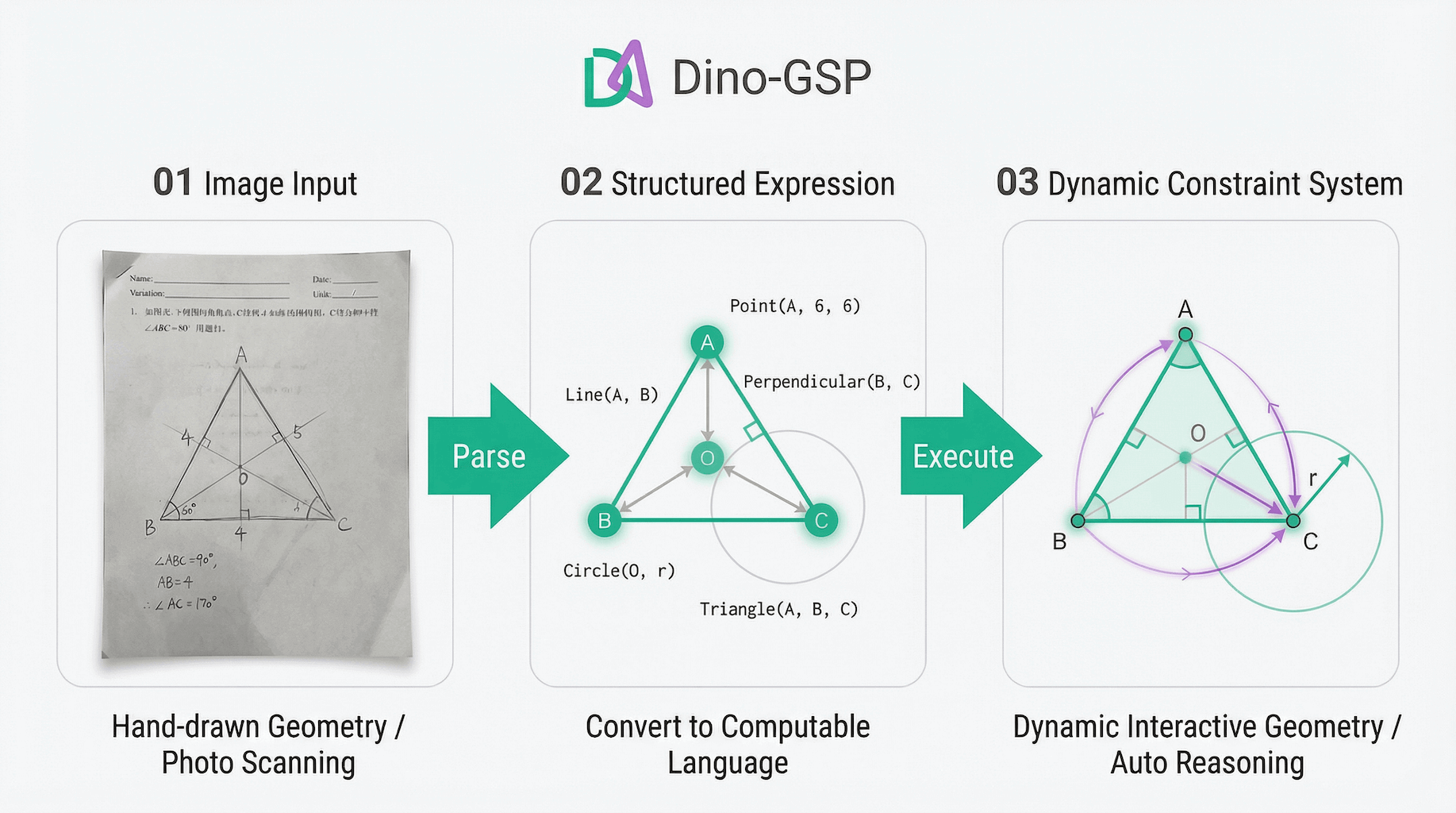
My original motivation for building Dino-GSP (大角几何) was to make figures themselves a constrained algebraic language.
What Dino Geometry is
Dino Geometry is a dynamic geometry board and math AI tool for AI geometry and math education. It represents figures as computable structures, so construction, modification, and verification can be executed and reproduced.
It is both:
- An AI geometry tool
- A math teaching tool
- A dynamic geometry board
- A geometry construction system that can be generated structurally
But its core is not simply easier drawing. It turns geometry from a visual result into an executable object to support higher-layer systems in the AI era.
How It Differs from Traditional Geometry Boards
Traditional dynamic geometry boards rely on interactive operations to complete constructions.
Dino Geometry uses a mathematical algebraic language to define and operate figures in a normalized way, making them executable by programs.
This creates two shifts:
-
Figures become programmable Generation and modification no longer depend on manual dragging, but can be done through rules and structural descriptions
-
AI can participate The system can automatically generate figures that satisfy conditions and participate in construction and reasoning
So Dino-GSP (大角几何) is not only a board, but also a specification for geometric expression.
The Key AI Geometry Problem It Solves
In geometry, AI's biggest difficulty is not understanding. It is construction and computation.
In traditional tools:
- Complex figures require extensive manual operations
- Auxiliary lines depend on personal experience
- Exploration is inefficient and hard to reproduce
With structured protocols plus AI generation capability, Dino Geometry can:
- Automatically generate figures that satisfy constraints
- Automatically draw auxiliary lines and structures
- Provide a verifiable environment for step-by-step derivation
In mathematical exploration, this means students and researchers can discover relationships and verify hypotheses faster, instead of being blocked by tedious construction work.
Use Cases
Teaching
By dragging while preserving geometric properties, students understand why a statement holds instead of memorizing conclusions.
Solution Authoring
Turn key structures into reproducible figures instead of one-off screenshots.
Mathematical Exploration
Automatically generate auxiliary structures to accelerate relationship discovery.
Content Production
Batch-generate geometry diagrams with consistent standards for item banks, textbooks, and courseware.
Value: From Presentation Tool to Derivation Tool
Traditional geometry boards solve expression, theorem provers solve proof, and Dino Geometry focuses on the middle process.
When figures become structured objects, geometry is no longer a static result, but a process that can be operated, modified, and verified.
This means learning shifts from passive intake to active experimentation; problem solving shifts from hunting answers to constructing processes; content shifts from display to reproducible structure; and AI shifts from tool to participant.
FAQ
What is the essential difference between Dino-GSP (大角几何) and traditional dynamic geometry boards?
It uses a mathematical algebraic language to standardize figure definition and operations, making generation and modification programmable, and combines this with AI to generate figures that satisfy constraints automatically.
What key pain point does it solve for AI geometry?
It reduces manual construction for complex figures, uses AI to generate structures and auxiliary lines, and improves both exploration efficiency and reliability.
What interaction modes are available for AI drawing?
It supports natural language, templates, parameterized input, and hybrid modes, so users can describe and generate figures in different ways.