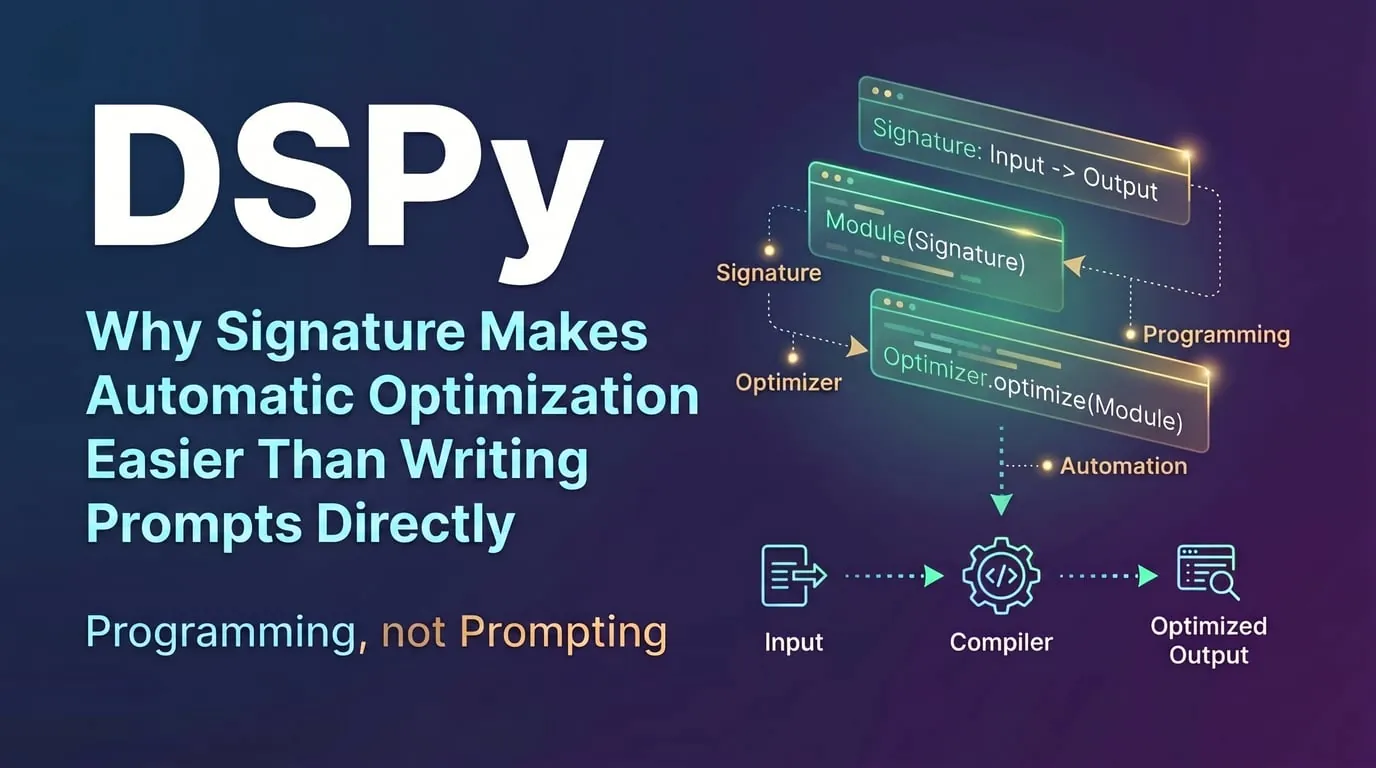
One useful thing I ran into while building recently: DSPy.
While building Canviz's content generation pipeline, I kept running into the same engineering problem: explanation quality and whiteboard-script reliability were both important, but it was hard to keep both stable with prompt text alone. As soon as I switched models or added a new grade level, I had to retune the string again. DSPy gave me a more systematic way to think about it.
If you are looking for a practical DSPy tutorial, a cleaner prompt engineering workflow, or a better way to optimize LLM pipelines, the core idea is simple: define the task as a Signature first, then let DSPy optimize the prompting layer around it.
The Core Tension in Prompt Engineering
Before talking about DSPy, it is worth stating one thing clearly: why is handwritten prompting an engineering problem rather than just a craft problem?
Traditional prompts have a structural flaw: they mix together "what the task is" and "how to tell the model to do it."
That one natural-language string is doing two jobs at once:
- It describes the task logic: what the inputs are and what outputs should come back.
- It acts as a model-specific incantation tuned for the current model.
Take a math-teaching example. The task logic of "explain a chicken-and-rabbit cage problem to a student" is stable. But the spell that works well for GPT may not be the one that works well for Claude Sonnet. Once you switch models, or move from grade 3 to grade 5, the spell may break. Worse, there is usually no systematic way to repair it beyond trial and error.
That is just hardcoding by another name. In normal software engineering, we already know not to freeze core logic into brittle literals. In LLM pipelines, though, we often lock core behavior into a fragile string.
DSPy's author, Stanford researcher Omar Khattab, describes the problem like this:
LM pipelines are often implemented as hard-coded prompt templates discovered by trial and error, and they are unusually brittle.
What Is DSPy, and What Is the Key Insight?
DSPy (Declarative Self-improving Python) is a framework open-sourced by Stanford NLP in 2023 and published at ICLR 2024. Its core claim is:
Programming language models, not prompting them.
The solution is elegant: separate the task interface from the concrete prompt implementation.
You tell DSPy:
- what each step takes in and returns,
- what the pipeline structure is,
- and how success should be evaluated.
Then DSPy's compiler and optimizer search for a better prompt strategy for your chosen model, data, and metric.
The official analogy is useful here: it feels a bit like moving from assembly to a higher-level language, or from handwritten SQL to an ORM.
Three Core Ideas That Explain DSPy
1. Signature: the task type signature
A Signature is DSPy's interface description. You specify what the step does, not how to word it:
import dspy

class ExplainMathProblem(dspy.Signature):
    """Explain a math problem to a student at a specified grade level."""
    problem: str = dspy.InputField(desc="Original math problem")
    grade: int = dspy.InputField(desc="Student grade, e.g. 3 means third grade")
    explanation: str = dspy.OutputField(desc="A step-by-step explanation suitable for the grade")
    key_concept: str = dspy.OutputField(desc="The main concept tested by the problem")
There is no handwritten prompt here. There is only interface semantics, not roleplay wording like "You are a patient and caring math teacher."
2. Module: composable functional blocks
Modules are DSPy's execution units, inspired by PyTorch's nn.Module. You can compose them into a full pipeline:
class MathLessonPipeline(dspy.Module):
    def __init__(self):
        # Step 1: explain the problem
        self.explain = dspy.ChainOfThought(ExplainMathProblem)
        # Step 2: generate a matching DinoGSP visualization script
        self.generate_diagram = dspy.Predict(
            "problem, explanation -> dinogsp_script: str"
        )
        # Step 3: create a similar practice exercise
        self.make_exercise = dspy.Predict(
            "problem, key_concept, grade -> exercise: str, answer: str"
        )

    def forward(self, problem, grade):
        # Explain
        step1 = self.explain(problem=problem, grade=grade)
        # Generate diagram
        step2 = self.generate_diagram(
            problem=problem,
            explanation=step1.explanation
        )
        # Create exercise
        step3 = self.make_exercise(
            problem=problem,
            key_concept=step1.key_concept,
            grade=grade
        )
        return dspy.Prediction(
            explanation=step1.explanation,
            dinogsp_script=step2.dinogsp_script,
            exercise=step3.exercise,
            answer=step3.answer
        )
Across the whole three-step pipeline, no prompt string is manually written. What you write is the logic structure.
DSPy also ships several common reasoning strategies:
| Module | Reasoning style | Example use in teaching |
|---|---|---|
dspy.Predict | direct prediction | difficulty grading, concept labeling |
dspy.ChainOfThought | chain-of-thought | step-by-step explanations |
dspy.ReAct | think-act loop | tool-based script validation |
dspy.ProgramOfThought | programmatic reasoning | executable math code generation |
3. Optimizer: the auto-tuning engine
This is the most distinctive part of DSPy.
You provide:
- an evaluation dataset, such as 100 problems with human-annotated references,
- and a metric function that decides whether the output is good enough.
Then the optimizer searches for stronger prompt instructions and better few-shot examples:
# Define the metric: is the explanation age-appropriate, and does the script parse?
def lesson_quality_metric(example, prediction, trace=None):
    explanation_ok = len(prediction.explanation) > 50  # minimum length
    script_parseable = validate_dinogsp(prediction.dinogsp_script)  # valid script
    grade_appropriate = check_vocabulary_level(
        prediction.explanation, example.grade
    )  # age-appropriate wording
    return explanation_ok and script_parseable and grade_appropriate

# Optimize with MIPROv2
optimizer = dspy.MIPROv2(metric=lesson_quality_metric, auto="medium")
optimized_pipeline = optimizer.compile(
    MathLessonPipeline(),
    trainset=annotated_lessons
)

# Save the result and load it directly in production later
optimized_pipeline.save("./optimized_math_lesson.json")
A medium run costs time and money, but the return is a content-generation system tuned to a specific model, dataset, and metric rather than a lucky handwritten prompt.
A Data Point Worth Looking At
One official DSPy result that stuck with me is from HotPotQA, a multi-hop reasoning benchmark.
Using dspy.ReAct with a gpt mini series model:
- accuracy was around 24% before optimization,
- and reached around 51% after MIPROv2 optimization on 500 examples.
The important point is not that a more expensive model was used. It is that the same class of model became much better at the task through optimization.
How It Differs from LangChain and LlamaIndex
A reasonable question is whether DSPy matters if you already use LangChain.
LangChain / LlamaIndex are orchestration frameworks. They are good at wiring together LLMs, vector stores, retrieval, and tool calls, but the prompts are still usually human-written strings. When the model changes, you often still have to go back and edit prompts by hand.
DSPy is closer to a compiler framework for AI programs. It does not just connect components. It tries to take over prompt generation and optimization as well. The developer writes the logic; DSPy searches for a better natural-language realization of that logic for a given model.
The difference becomes obvious in a math-education pipeline:
- With LangChain, if you built a "third-grade explanation" flow and tomorrow need fifth-grade support, you usually revisit the prompt strings manually.
- With DSPy, you are more likely to change the inputs, dataset, or evaluation target, then recompile and let the framework search again.
If I had to compress it into one analogy: LangChain is an automation assembly line; DSPy is a higher-level language with a compiler.
My Developer View: What It Solves, and What It Still Does Not
What DSPy genuinely solves
- Model migration pain: when moving from GPT-5.4 to a cheaper model, you can recompile instead of rewriting all prompts.
- Joint optimization across steps: explanation quality and diagram-script usability can be optimized together instead of separately.
- Experiment reproducibility: optimized results can be saved as JSON and shared across the team.
Where it is still hard
- Metrics are the hardest part: a function like
validate_dinogsp()has to be designed carefully, or the optimizer will exploit loopholes. - Optimization is not free: as datasets, model costs, and optimization rounds grow, the bill grows too.
- Debugging is still maturing: when the optimized pipeline is still not good enough, it is often hard to tell whether the bottleneck is the dataset, the metric, or the model itself.
When Should You Use DSPy?
Good fit
- You are building a multi-step LLM pipeline.
- You need to switch between different models.
- You have an evaluation dataset and measurable quality targets.
- You are tired of vibe-based prompt tuning.
- You need something maintainable in production.
Probably not a good fit
- You are only validating an idea quickly.
- The task has no clear metric, so the optimizer has nothing reliable to optimize against.
Closing Thought
What I like most about DSPy is not just that it can auto-optimize prompts. It pushes a more reliable engineering mindset:
In an AI pipeline, prompts are closer to parameters than source code.
Just as I would not hardcode neural-network weights into source files, I should not treat a prompt tuned for one model as the program logic itself. Those prompts are better treated as artifacts that can be learned, optimized, saved, and migrated.
The logic of teaching content is stable: step-by-step explanation, visual support, age-appropriate wording. But how to get a model to deliver that changes with model upgrades, new grades, and new problem types. DSPy separates those two layers, which is what makes an AI teaching system actually maintainable.
If you are building in AI education, content generation, or multi-step agent systems, this is worth a serious look.
References
- DSPy docs: dspy.ai
- Paper: DSPy: Compiling Declarative Language Model Calls into Self-Improving Pipelines, ICLR 2024
- GitHub: stanfordnlp/dspy
- Optimizer guide: dspy.ai/learn/optimization/optimizers