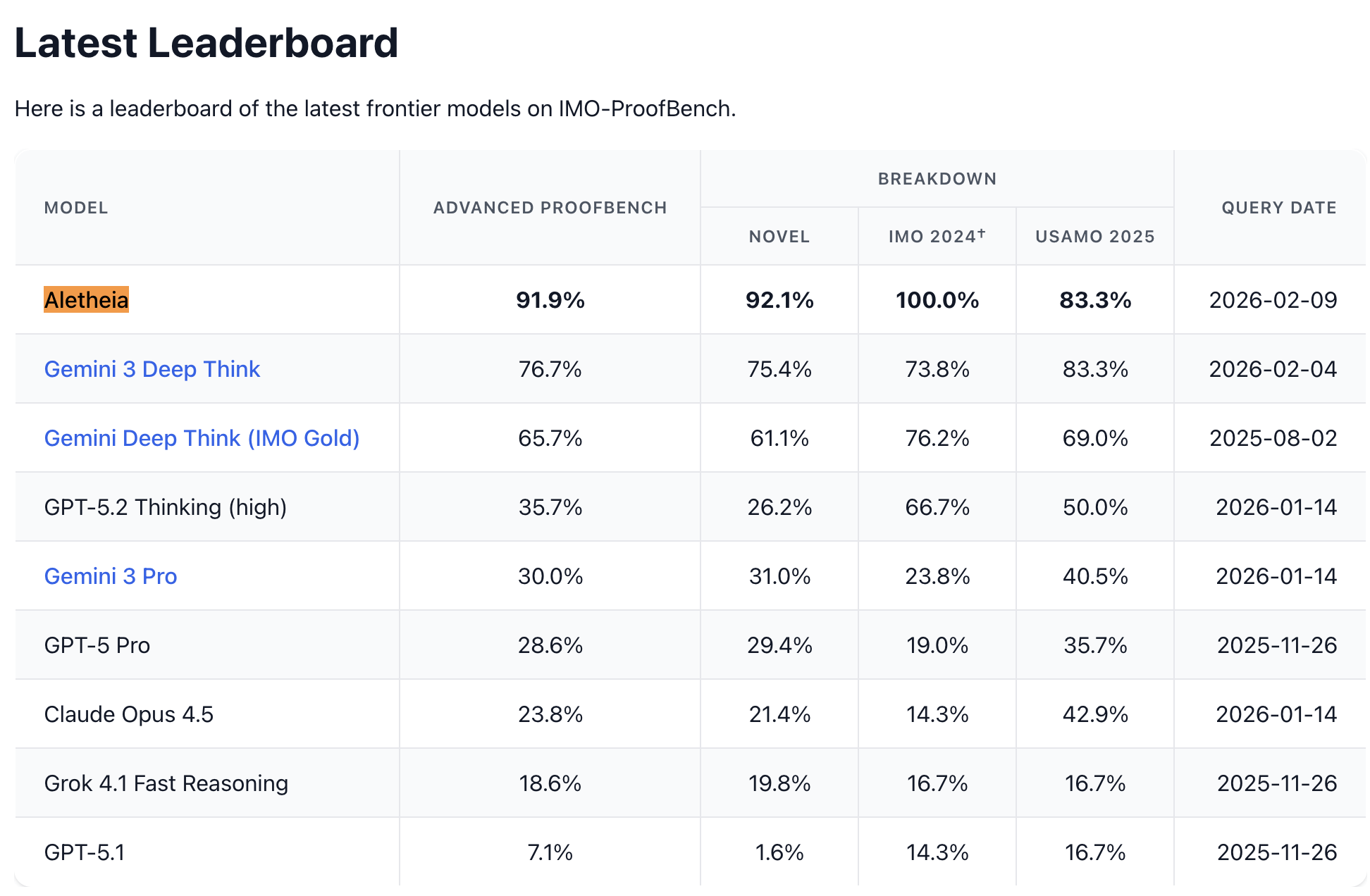
Google DeepMind Aletheia leads the IMO-ProofBench Advanced benchmark with an impressive ~91.9% score.
It also significantly outperforms baseline systems on hard USAMO 2025 problems. On harder internal benchmarks, it surpasses earlier reasoning models as well; while gaps still remain, it is clearly ahead of prior baselines.
Recent discussion around Aletheia feels familiar.
Headlines say “AI mathematician,” and comments ask: “Is it going to replace mathematicians? Can it already do autonomous research?”
I carefully reviewed the Aletheia paper and dataset, then organized the key architecture and practical implications I learned. That is exactly what this essay is about.
1) The Road to DeepMind Aletheia
Looking at the timeline, it is clear that Google DeepMind has been building toward this for a long time.
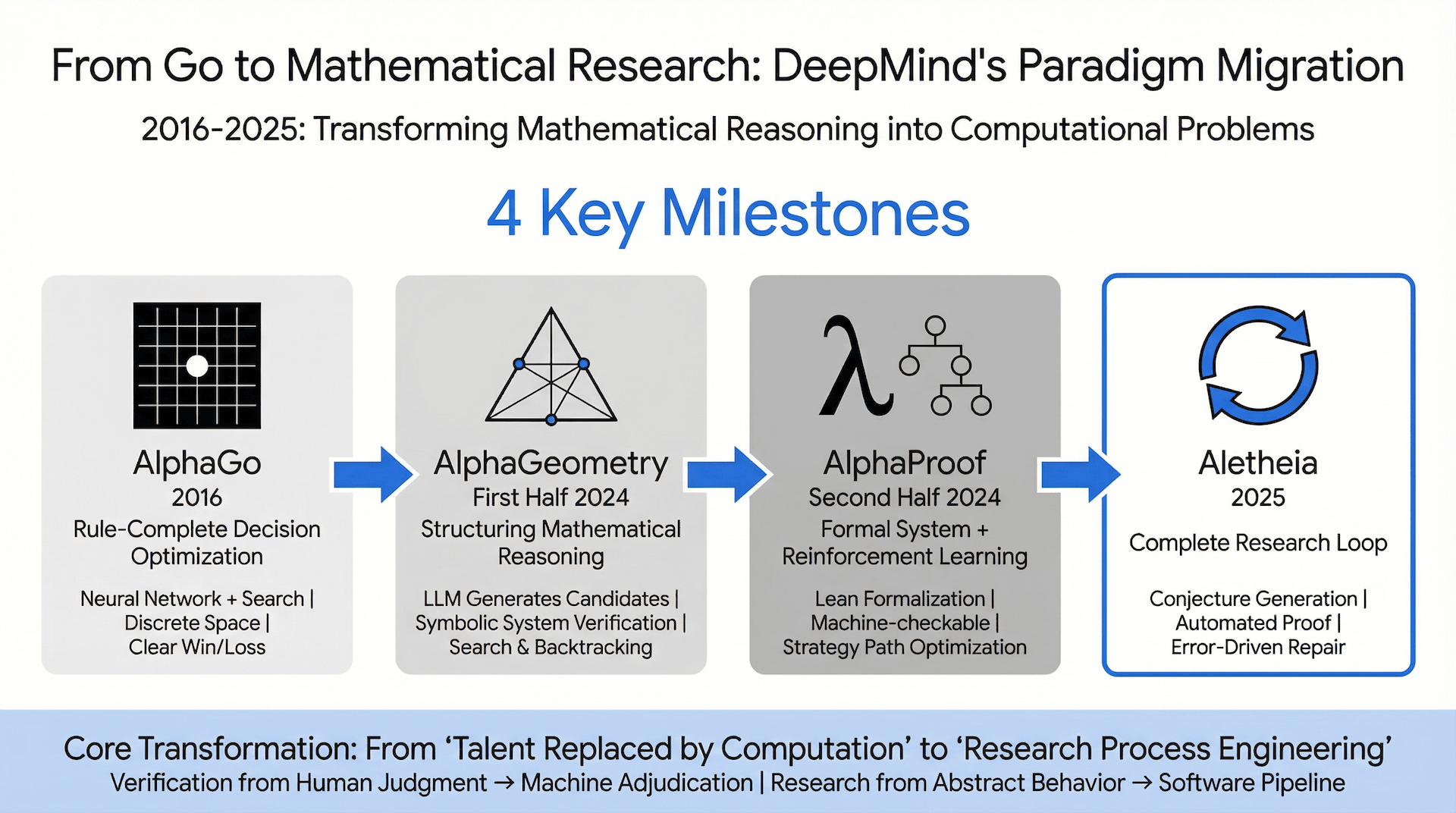
When AlphaGo appeared in 2016, the underlying question was already there: How do you optimize decision trajectories inside a system with complete rules and a clear evaluation function?
A board game is discrete, outcomes are decidable, and the search space is huge but structured. That is an ideal environment for strategy optimization.
DeepMind’s “neural networks + search” was never just about Go. It tested a broader hypothesis: if a problem can be strictly described and each step can be judged as correct or incorrect, “talent” can be partially replaced by computation.
With AlphaGeometry in 2024, the question shifted: Can mathematical reasoning also be placed inside a rule-closed system like this?
AlphaGeometry’s key design:
- LLM proposes auxiliary construction candidates
- A symbolic geometry system verifies constraints
- Search handles backtracking and expansion
For the first time in this context, the LLM does not decide truth; it proposes possibilities, and structural systems guarantee logical validity.
That transition matters: Google had begun to place math reasoning inside a verifiable loop.
In late 2024, AlphaProof moved the battlefield into formal systems such as Lean. The question became: If geometry can be structured, can all of mathematics be formalized to machine level?
By entering Lean-like systems, AlphaProof sharply narrows expression:
- every step must be machine-checkable,
- the type system imposes strong constraints,
- vague language no longer works,
- proofs are not “plausible”; they must pass verification.
It also adds reinforcement learning to optimize strategy paths, so the system does not just write proofs; it learns tactic selection, goal decomposition, and branch value estimation.
From this point on, DeepMind’s direction becomes explicit: turn mathematical behavior into a schedulable search problem.
Aletheia is the continuation of that path, and currently its strongest result.
2) What Is Actually Worth Discussing About Aletheia
Saying “it can autonomously propose and prove conjectures” is still too shallow.
The hardest core of Aletheia has three parts: closed loop, structure, and scheduling.
If that loop runs stably, mathematical research truly begins to move beyond purely human time scales.
2.1 It really built a runnable research loop
Most “math AI” systems are still input problem -> output answer.
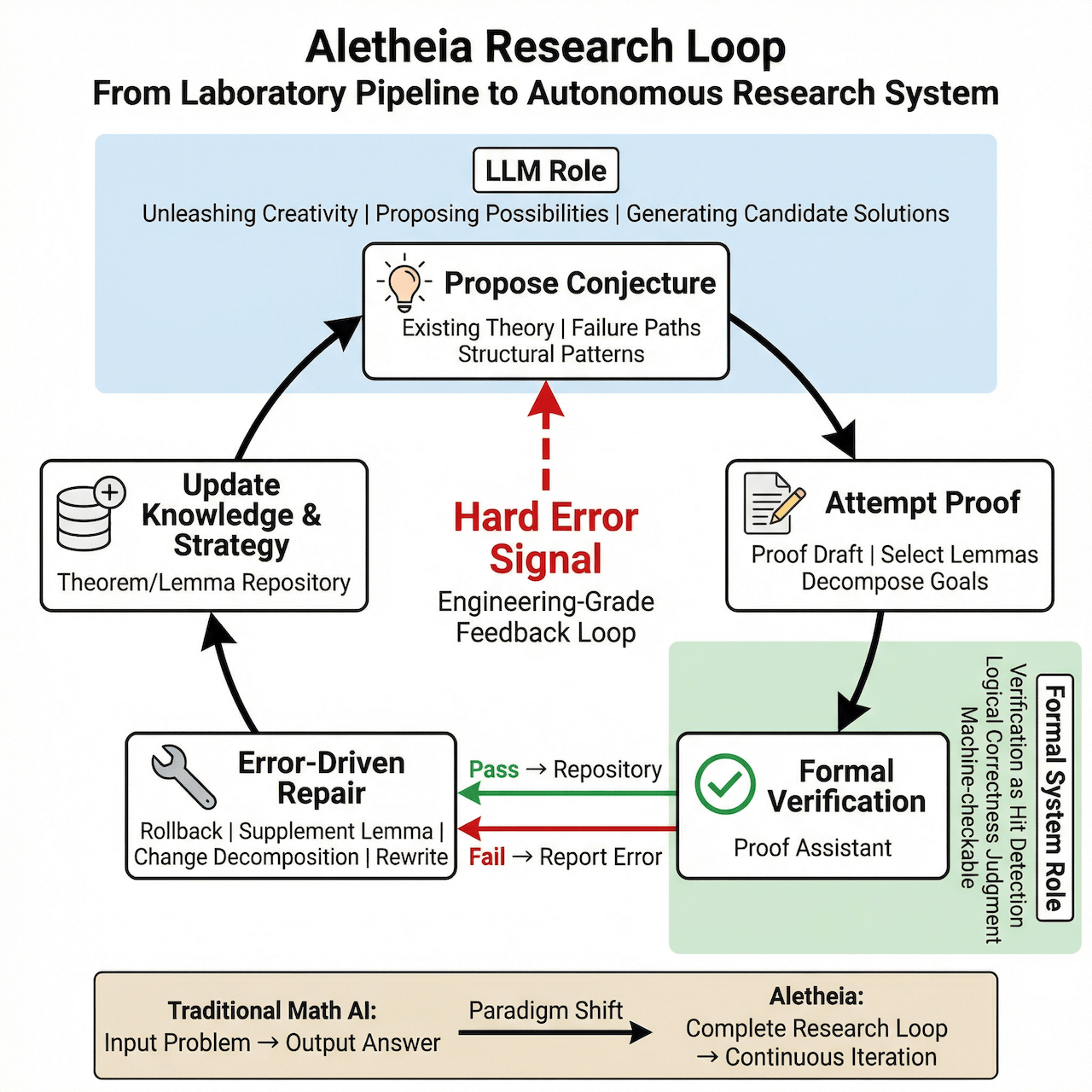
Aletheia looks more like a laboratory pipeline. A minimal loop looks like this:
- Conjecture proposal: generate statements from existing theory, failed paths, or structural patterns
- Proof attempt: generate drafts, choose lemmas, decompose goals
- Formal verification: send to a proof assistant; accepted results are stored, failures return hard errors
- Error-driven repair: rollback, add lemmas, change decompositions, rewrite conjectures
- Knowledge/strategy update: feed newly proved theorems/lemmas back into the system for the next round of generation/search
The key is that failure is not “weak quality”; it is a hard error signal. That makes the feedback loop engineering-grade.
You can think of it as LLM for creative candidate generation, while formal systems decide whether anything actually hits the target.
2.2 The core is not the model; it is IR and verification interfaces
When people see a new SOTA math result, the default reaction is often “bigger and stronger model again.”
But in formal math, system ceilings are usually set less by parameter count and more by representation: how do you encode a theorem or proof state, map “ideas” into checkable syntax trees, and turn proof-assistant feedback into learnable signals?
In that sense, Aletheia is closer to a “math compiler + debugger + search engine” stack.
This requires a heavy middle layer:
- Theorem Graph / Lemma Graph: dependency graph across results
- Goal-state representation: structured encoding of current proof state (goal, hypotheses, type constraints)
- Tactic/step representation: executable action space for proving (similar to AlphaProof action spaces)
Without this, even a strong model can only produce “essay-style proofs” that do not land in formal systems.
2.3 Why the engineering meaning is bigger than the score
Scores are outcomes. Engineering value is reusable method.
If Aletheia really has those three layers, then:
- mathematical research can be decomposed into an action space + feedback + policy optimization paradigm,
- formal systems move correctness from human review to machine adjudication,
- LLMs move from judge to candidate generator, reducing hallucination blast radius.
The value of this route is that it turns “research” from an abstract human process into something software systems can implement.
Put differently: it gives research a CI/CD-like pipeline flavor—propose, verify, fail, repair, merge.
3) What Happens After Research Behavior Is Engineered?
One long-standing bottleneck in mathematics is verification cost.
Complex proofs can take months or years for peer confirmation. Human review time is scarce.
Formal systems shift correctness from human judgment to machine judgment. Once verification is no longer the bottleneck, generation speed becomes the main variable.
Imagine a system that expands theorem graphs daily, outputs large volumes of intermediate lemmas, and continuously reorganizes dependencies.
It may not solve grand open problems immediately, but it will keep filling theoretical space.
What changes under scaled research output?
My guess: first, rhythm.
The field’s rhythm has long been constrained by human verification throughput. If verification is machine-managed, the speed of theoretical expansion will rise sharply. Then the scarce resource is no longer proving ability, but problem selection and theory organization.
When proposition-generation speed exceeds human reading speed, disciplinary rhythm breaks.
Final Notes
If you are also working in education + AI, I am fairly confident about this: purely text-based “solution explanation” AI products will become harder to sustain.
As formal systems integrate and verification gets standardized, products that only explain steps will be pushed to the margins.
Future defensibility will likely require three things:
- A structural intermediate layer: not just text output, but executable objects
- Built-in verification: machine checking as a default capability
- Exploration mode support: let learners propose conjectures, test hypotheses, and observe failure feedback
Teaching systems will increasingly resemble small theorem environments, not chat-only bots.
This path is not easy. It likely requires at least DSL or formal representation capabilities, plus executable constraint systems and interfaces to provers/verification engines.
But if the Aletheia direction continues, this is likely a long-term trend.
Further Reading
- Google DeepMind. Accelerating Mathematical and Scientific Discovery with Gemini Deep Think. Official Blog Post, 2026.
- Google DeepMind. AlphaGeometry: An Olympiad-Level AI System for Geometry. Official Blog Post, 2024.
- Google DeepMind. Towards Autonomous Mathematical Research. arXiv preprint, 2026.